TL;DR - Too Long; Didn't Read
If you're reading this, chances are you're already using Signal for your private conversations. You understand the importance of end-to-end encryption, you value genuine privacy over convenience, and you've probably convinced at least a few friends and family members to make the switch from WhatsApp or SMS. But here's a question that might surprise you: where do you store your private thoughts, sensitive documents, and confidential notes?
Where Does Signal Stop Protecting You?
The uncomfortable truth is that most Signal users are undermining their own privacy the moment they step outside their messaging app. They're using Google Keep for quick notes, storing sensitive photos in their regular camera roll, or trusting Evernote with confidential documents. It's like installing a bulletproof door on your house while leaving all the windows wide open.
This privacy paradox affects millions of security-conscious individuals who understand the importance of encrypted communication but haven't extended that same level of protection to their personal information storage. The result? A false sense of security that can have devastating consequences when it matters most.
Take Back Your Privacy
Use EchoVaults
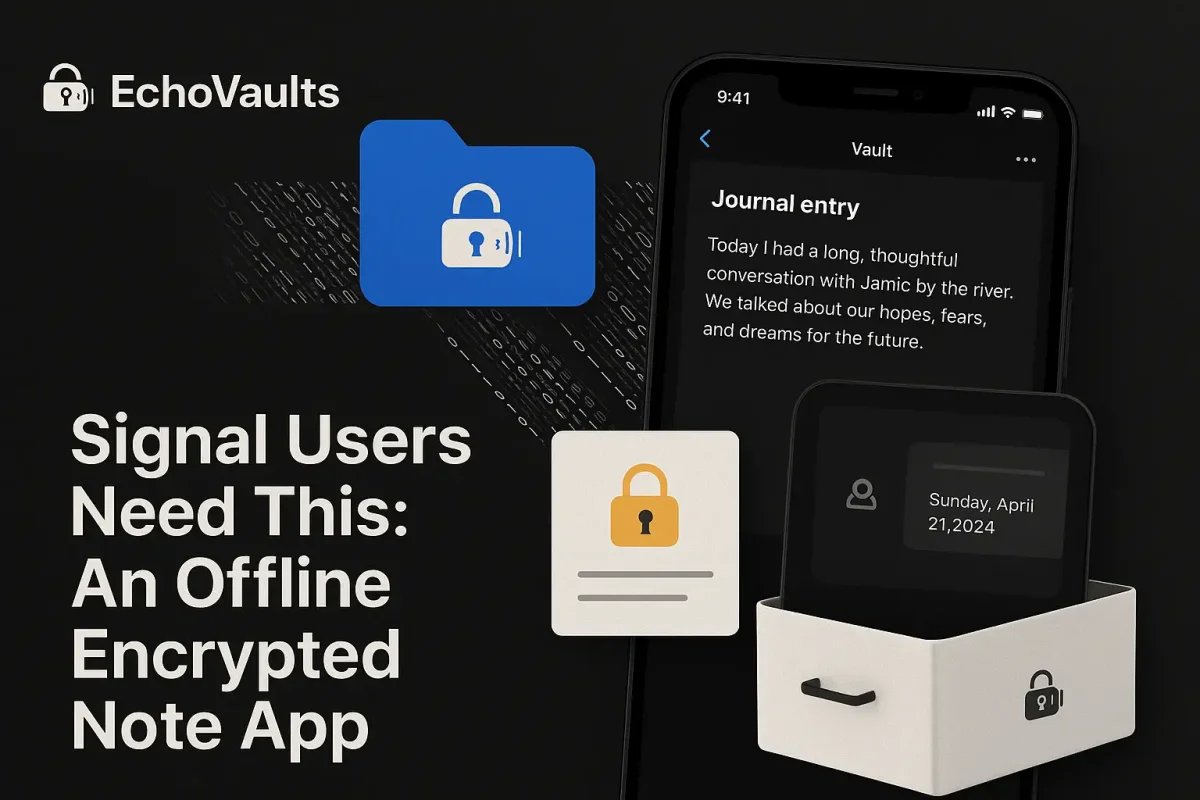
Store your most sensitive information such as images, files, videos, data, passwords with military grade encryption. Completely offline, secured and free.
The Hidden Privacy Gap That Signal Can't Fill
Signal revolutionized private messaging by proving that strong encryption and usability aren't mutually exclusive. Signal is a messaging app with privacy at its core. It is free and easy to use, with strong end-to-end encryption that keeps your communication completely private. But messaging is just one piece of the digital privacy puzzle.
Consider this scenario: You're a journalist working on a sensitive story. Your conversations with sources are protected by Signal's encryption, but what about your research notes? Your document drafts? The photos of evidence you've collected? If these are stored in standard note-taking apps, they're sitting unprotected in cloud servers, available to anyone with the right access credentials or a valid subpoena. Finding the best offline encrypted notes alternative to Evernote becomes critical for investigative work.
Or perhaps you're a business professional who uses Signal for confidential client communications. Your messages are secure, but are your meeting notes? Your contract drafts? The confidential financial information you need to reference? The disconnect between your messaging security and your information storage creates a vulnerability that most people don't even realize exists.
This gap becomes even more critical during emergencies or unexpected situations. Every day, critical information dies with its keeper. Life-saving details, private memories, financial secrets, business intel—all lost forever. The same privacy-conscious mindset that led you to Signal should extend to how you store and protect your most sensitive information.
Why Traditional Note Apps Fail Users
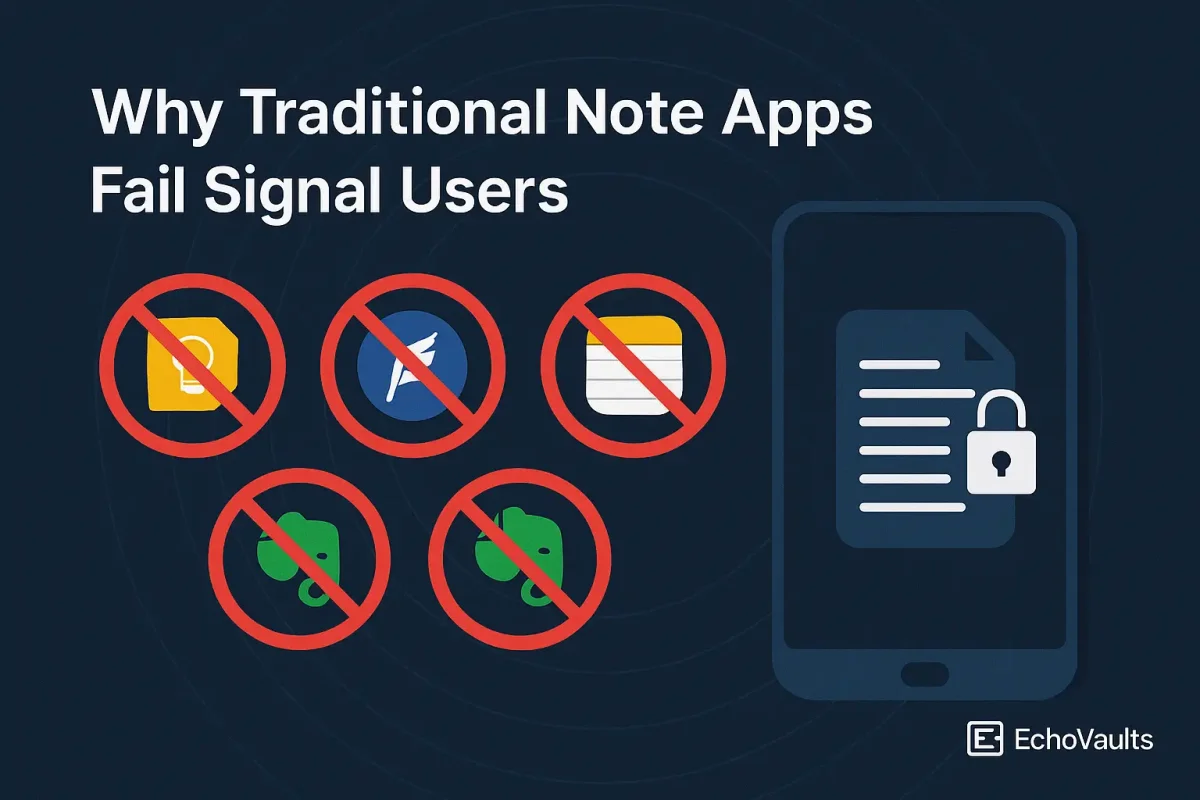
Signal users have already demonstrated that they're unwilling to compromise on privacy, yet the note-taking apps they're likely using fall far short of Signal's standards. Let's examine why the popular alternatives don't measure up.
Standard Notes and the Email Problem
Standard Notes is an open-source software project that promotes transparency and confidence among privacy-focused users. It uses end-to-end encryption, regardless of the devices (e.g. Mac, Windows, Mobile) you are using. On the surface, this sounds perfect for Signal users. But here's the catch: to sync across different devices, you will need to register using your email address.
This email requirement creates a permanent link between your identity and your encrypted data. Even if the content is encrypted, metadata about your usage patterns, the timing of your notes, and your email address are all stored on Standard Notes' servers. For Signal users who understand that metadata can be just as revealing as content, this represents a significant privacy compromise.
Notesnook's Cloud Dependency
Notesnook encrypts all your data before it even leaves your device and markets itself heavily to privacy-conscious users. But like most modern note apps, it's built around cloud synchronization. Your notes are stored encrypted in the cloud, on your device, and in transit. While the encryption is strong, the fundamental architecture still requires trust in external servers and internet connectivity.
Signal users often choose the app specifically because they don't want to rely on cloud services for their most sensitive communications. The same principle should apply to their note storage, no?.
The Google and Apple Ecosystem Trap
Many Signal users fall back on device built-in solutions like Apple Notes or Google Keep for convenience. But these represent the antithesis of the Signal philosophy. Google Keep isn't encrypted at all, while Apple Notes only offers limited protection. Users can lock notes with a password, but they aren't end-to-end encrypted. The iCloud Security Overview page says notes are encrypted in transit and on the server.
The irony is stark: users who won't trust WhatsApp because it's owned by Meta are happily storing their most sensitive information with Google or Apple, companies whose business models are fundamentally built around data collection and analysis.
What Signal Users Actually Need in a Note App
Signal users didn't choose the app for its features—they chose it for its principles. The same principles should guide their choice of note-taking applications.
True Offline Operation
Signal users understand that the most secure communication is the kind that doesn't depend on external servers. Signal Protocol to encrypt everything. It's peer-reviewed, fast and effective, and, you guessed it, incredibly secure. The same logic applies to note storage. The most secure notes are the ones that never leave your device unless you explicitly choose to share them.
This means no cloud synchronization by default, no automatic backups to external servers, and no dependency on internet connectivity for basic functionality. Your notes should be as accessible during a network outage as they are when you're fully connected.
No Compromise Encryption
Signal users expect military-grade security, not marketing-grade promises. Just as Signal uses proven cryptographic protocols, a note app for Signal users should employ the strongest available encryption methods. This isn't just about protecting the content—it's about protecting metadata, access patterns, and any other information that could be used to compromise privacy.
Zero-Knowledge Architecture
The Signal Foundation operates on a zero-knowledge principle: they can't access your messages even if they wanted to. Signal is run by the non-profit Signal Technology Foundation. It's entirely funded by donations, so there are no ads, trackers, or other privacy-sacrifices made in the name of monetization. A note app for Signal users should operate on the same principle. The developers should be unable to access your content, your metadata, or even prove that you're using the application.
No Identity Requirements
Signal requires a phone number, which has always been a point of contention among privacy advocates. But at least this requirement serves a functional purpose for messaging. A note app has no such justification. There should be no email registration, no phone number requirement, and no user accounts that can be traced back to your identity (PII).
Prepared for Emergencies
Signal users often think about worst-case scenarios. They understand that the need for private communication is often highest during emergencies, political unrest, or personal crises. Similarly, a note app should be designed to function when traditional systems fail and to protect information that becomes critical during unexpected situations.
Beyond Signal's "Notes to Self" Limitations
Some Signal enthusiasts might point to the app's "Notes to Self" feature as a solution for private notes. While Signal offers 'Notes to Self', it was never meant for structured information storage or emergency preparedness. EchoVaults builds the secure architecture Signal users would design for themselves—if they were building a dedicated private notes app for journalists, lawyers, and other professionals who need more than basic messaging.
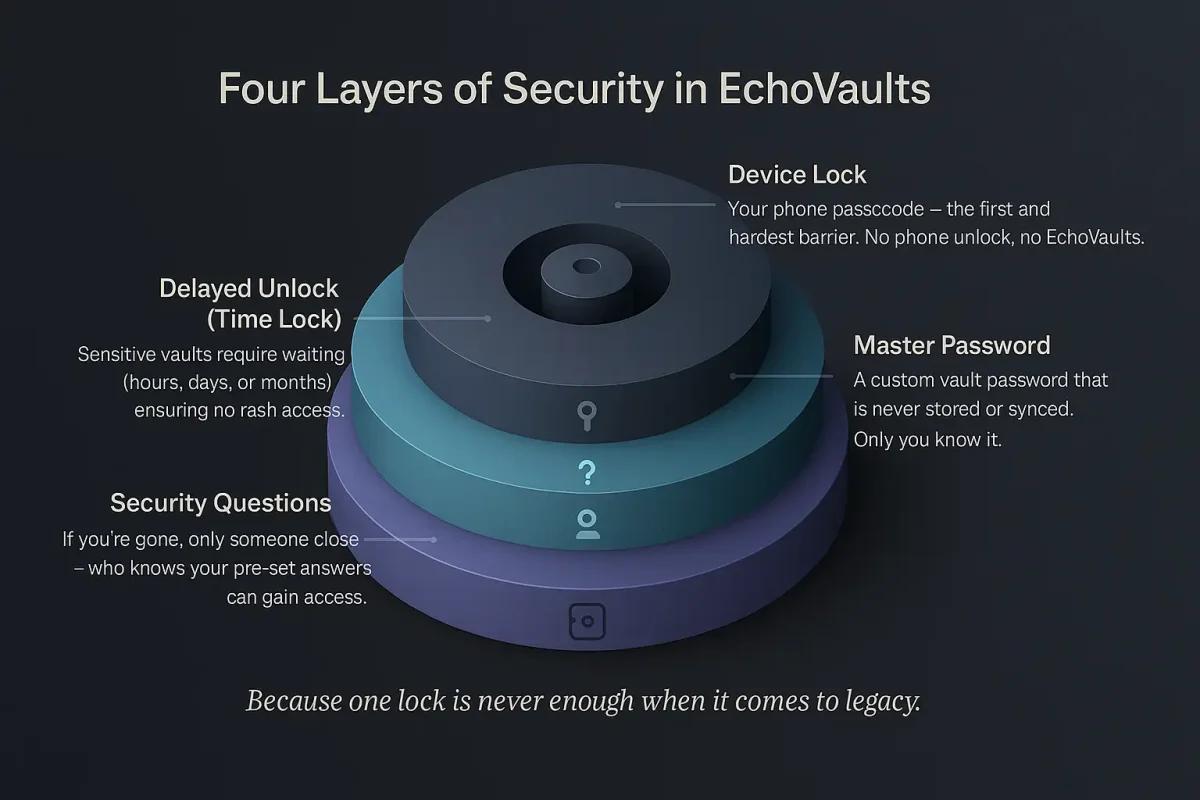
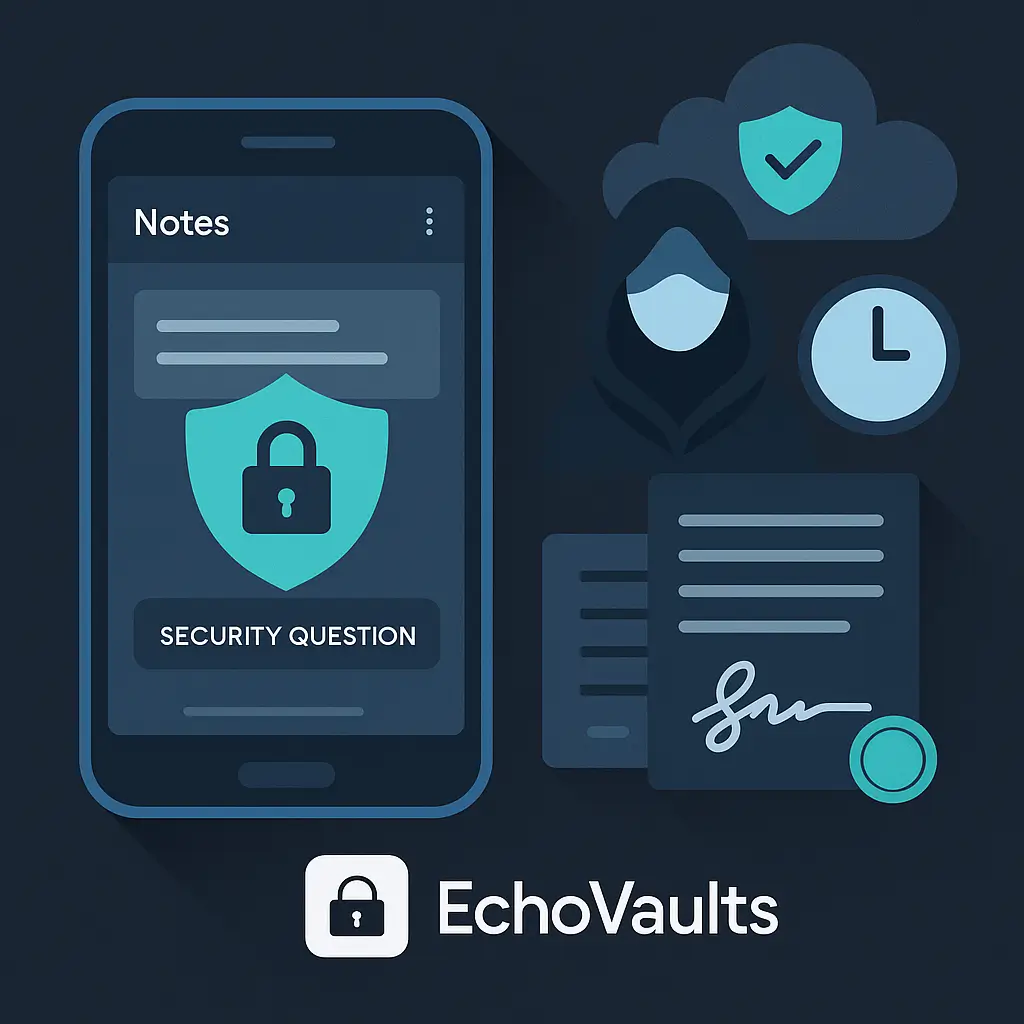
More importantly, EchoVaults addresses emergency scenarios that Signal simply can't handle. The app's layered access system allows basic information to be available to anyone who correctly answers your security questions, while ultra-sensitive data remains protected at the highest level. This emergency access capability—combined with time-locked vaults and legal timestamping—represents a fundamental difference in approach that goes far beyond what any messaging app could provide.
Introducing The Most Secured Note App Ever Built
EchoVaults represents what happens when you apply Signal's privacy philosophy to personal information storage. EchoVaults is a secure, offline-first mobile app that helps you prepare for unexpected loss, disappearance, death, or emergency. But this emergency focus shouldn't obscure its power as a daily-use privacy tool and the best secure note-taking app for privacy-conscious professionals who refuse to compromise on encryption. Let's explore EchoVaults use cases
- Prepare for emergency
- Prepare for traveling or going off-grid
- For Journalists saving sensitive files
- Serves as notepad for writing one's deepest thoughts
- To hide photos, videos and other media
- To hide local files and other valuables
- To hide sensitive and confidential notes
- To hide secrets
- To protect one's privacy
- To store passwords
-True Offline Privacy
EchoVaults isn't another cloud sync app pretending to care about privacy. The Vault doesn't need your email. doesn't ask for logins, hell doesn't even need internet. It's your information encrypted and stored only where it should be: with you.
This offline-first approach aligns perfectly with Signal user values. Just as Signal users appreciate that their messages don't live on corporate servers, EchoVaults ensures that your notes, documents, and sensitive files remain exclusively on your device. There's no cloud account to be compromised, no server to be hacked, and no corporation to change their privacy policy.
-Ultra-Sensitive Privacy Levels
EchoVaults goes beyond simple encryption by offering granular privacy controls that Signal users will appreciate. The "Ultra Sensitive" privacy level ensures that information remains hidden even from trusted individuals who might have access to your device in an emergency. This represents a level of privacy control that's simply unavailable in traditional note-taking applications.
Time-Locked Digital Vaults
Schedule access for when it's needed most
Set up emergency access for family members or schedule information to unlock at specific times. Your privacy remains intact until the moment it matters.
Learn About Privacy FeaturesFor Signal users who understand that different information requires different levels of protection, this granular approach makes perfect sense. Your casual notes might be accessible to trusted family members, while your most sensitive information remains protected at the highest security level.
-No-Recovery-by-Design Security
Hard no to recovery systems: If you forget your master password, it's lost by design (All Vaults data are not recoverable since they are not attached to any account) Small trade off for security.
This might sound extreme, but Signal and other privacy-conscious users will appreciate the logic immediately. True security requires accepting certain trade-offs. Just as Signal can't help you recover old messages if you lose your device, EchoVaults can't help you recover your data if you forget your password. This isn't a limitation at all, it's proof that the encryption is real.
And because EchoVaults is open-source, anyone can inspect the code and verify that the promises made here match what's actually in the app. This GitHub transparency aligns perfectly with Signal's commitment to auditable security, you don't have to trust the marketing, you can verify the implementation.
The alternative recovery systems that allow password resets inevitably creates backdoors that can be exploited by malicious actors. EchoVaults chooses security over convenience, just as Signal does.
Real-World Applications for Privacy-Conscious Users
Understanding how EchoVaults serves Signal and other privacy conscious users requires looking at specific scenarios where the combination of messaging and information storage privacy becomes critical.
Investigative Journalists and Sources
If you're a journalist using Signal to communicate with sensitive sources, EchoVaults provides the secure storage complement your workflow needs as the best private notes app for journalists. Your source communications are protected by Signal, but what about your research notes, document analysis, and story drafts? EchoVaults allows you to store this information with the same level of security as your communications.
The time-locked features become particularly valuable for investigative work. You can prepare information packages that become accessible to trusted colleagues if something happens to you, ensuring that important stories don't die with their investigators. Store legally-signed video testimonials explaining promises, with EchoVaults automatically appending legal signatures and timestamps. Digital witness statements would provide irrefutable evidence of intentions.
Legal and Medical Professionals
Lawyers and doctors who use Signal for client communications face similar challenges with document storage. Client communications are protected, but case files, medical records, and confidential documents often end up in standard cloud storage systems that don't meet the same security standards. For professionals seeking the best encrypted document storage app for confidential files, traditional solutions fall short.
EchoVaults provides a secure environment for storing sensitive professional documents while maintaining the offline-first approach that ensures client confidentiality isn't dependent on third-party servers or internet connectivity.
Business Executives and Entrepreneurs
Business leaders who rely on Signal for confidential discussions need equivalent protection for their strategic documents, financial information, and competitive intelligence. EchoVaults allows for secure storage of business-critical information while providing the emergency access features that ensure important information remains available to key stakeholders when needed.
The time-locked vault feature becomes particularly valuable for business continuity planning. Key information can be made accessible to trusted team members or family members after specific time periods or triggering events, ensuring that business operations can continue even during unexpected circumstances.
Political Activists and Dissidents
For activists operating in challenging political environments, the combination of Signal for communications and EchoVaults for document storage provides a comprehensive privacy solution. The offline-first approach ensures that sensitive information remains secure even if internet access is restricted or monitored.
The disguised nature of the information storage—where sensitive documents can be hidden even from individuals who have device access—provides an additional layer of protection against forced disclosure scenarios.
International Travelers and Digital Nomads
Signal users who travel internationally often face unique privacy challenges at border crossings and in countries with restrictive digital surveillance. EchoVaults' time-locked features allow travelers to prepare information packages that become accessible to family members or colleagues after specific time periods, providing security against extended detention or device confiscation.
The offline functionality ensures that critical information remains accessible even in areas with limited internet connectivity, while the advanced encryption provides protection against forced device searches.
The False Choice Between Security and Usability
One of Signal's greatest achievements was proving that users don't need to choose between security and usability. EchoVaults applies the same design philosophy to information storage, demonstrating that true privacy doesn't require sacrificing convenience or functionality.
Intuitive Security
Just as Signal makes end-to-end encryption invisible to users, EchoVaults implements advanced security measures without requiring users to understand cryptographic details. The app's interface guides users toward secure practices while maintaining the simplicity that makes daily use practical.
Progressive Privacy Features
EchoVaults allows users to start with basic privacy features and gradually adopt more advanced security measures as their needs evolve. This progressive approach mirrors Signal's strategy of providing strong default security while offering advanced features for users who need them.
No Technical Expertise Required
While EchoVaults implements sophisticated security measures, using the app requires no more technical knowledge than using Signal. The complexity of the underlying security architecture remains hidden behind an interface that prioritizes usability without compromising security principles.
As digital privacy concerns continue to evolve, the artificial separation between communication security and information storage security becomes increasingly untenable. Signal users represent the early adopters of this integrated privacy approach, understanding that comprehensive digital security requires attention to all aspects of information management.
EchoVaults points toward a future where privacy tools work together to create comprehensive security environments rather than addressing isolated use cases. For Signal users who have already committed to the principle that privacy is not negotiable, EchoVaults provides the natural extension of that commitment to information storage.
Completing Your Privacy Architecture
If you're an extremely privacy consious individual or you use, you've already demonstrated that you understand the importance of digital privacy and are willing to prioritize security over convenience when necessary. EchoVaults represents the logical next step in building a comprehensive privacy architecture that protects not just your data, but all of your sensitive information, and files.
The same principles that led you to Signal—the rejection of surveillance capitalism, the demand for real encryption, the understanding that privacy is a fundamental right—should guide your choice of information storage tools. EchoVaults doesn't just store your notes; it protects your digital legacy with the same uncompromising approach to privacy that Signal brings to communication.
In a world where privacy is increasingly rare, Signal helps users to avoid privacy invading social app and EchoVaults allows you to extend that choice beyond messaging to encompass all of your sensitive information and files. True privacy isn't just about who can read your messages—it's about who controls your entire digital footprint.
The question isn't whether you need secure information storage. If you're using Signal, you've already answered that question. The only question is whether you're willing to extend the same security standards to the rest of your digital information, data and files. EchoVaults makes that choice simple, secure, and uncompromising.
Your communications are already protected. Isn't it time to protect everything else?